When you create a Manufacturing Order to assemble a finished product, Erplain automatically calculates its cost of goods (the assembly valuation).
This guide explains in detail how this cost is determined, to help you accurately track the profitability of your inventory.
The 3 pillars of valuation
The valuation of a manufactured product combines three key elements:
1. The cost of consumed components (Bill of Materials)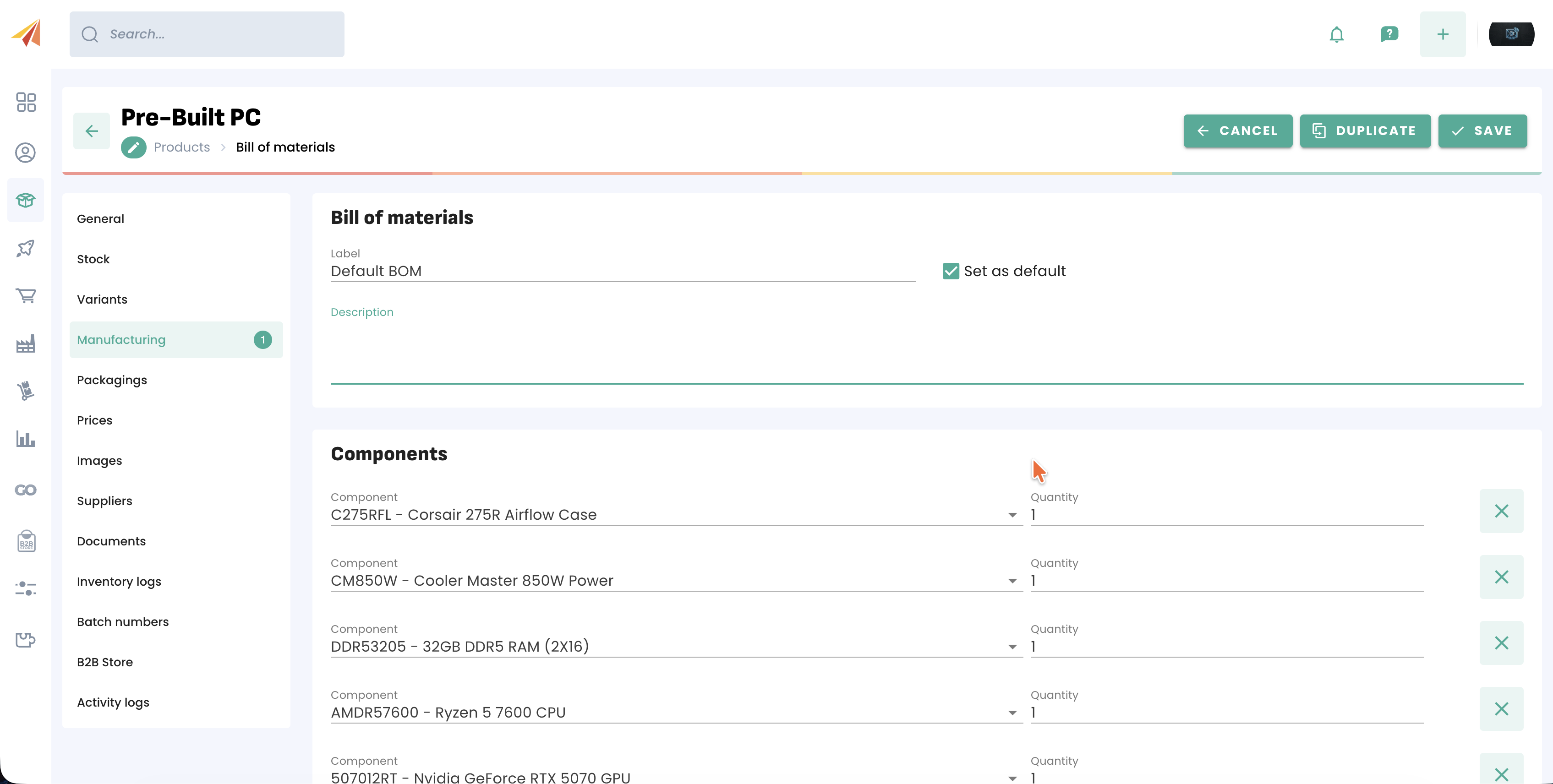
For each component actually used during manufacturing:
- Products with inventory tracking: Erplain retrieves its exact value from your inventory at the time of consumption, based on your valuation method: MAC (Moving Average Cost) or FIFO/LIFO.
- Products without inventory tracking: Erplain uses the default unit cost defined manually on its product record.
2. The unit manufacturing cost
These are the direct costs (labour, machine costs, electricity, etc.) associated by default with the production of one unit of finished product. You can define this cost on your assembled product record or enter it directly in the manufacturing order form.
3. The exceptional manufacturing cost
This is an additional, optional cost that you can manually add to the manufacturing order to cover unforeseen circumstances (for example, an extra cost charged by a subcontractor or a broken machine).
Valuation calculation
Calculation formulas — Manufacturing Order
1/ – Cost of components used
Total Component Cost = Σ ( Quantity used × Unit cost )
The unit cost corresponds to the WAC or the FIFO/LIFO batch cost at the time of stock withdrawal.
2/ – Total valuation of the Manufacturing Order
Total Valuation = Total Component Cost + ( Unit manufacturing cost × Quantity produced ) + Exceptional costs
3/ – Unit cost of goods
Unit Cost of Goods = Total Valuation / Quantity produced
+ potential stock entry value, used to recalculate the valuation of the finished product.
The impact on your stock valuation
Once production is finalised:
- Stock removal: Components are removed from inventory at the cost determined at the time of manufacturing.
- Stock entry: Finished products are added to your inventory at their new valuation.
- Update: The valuation of your finished product is automatically updated, taking into account existing stock and this new production batch.
The disassembly case
If you perform a disassembly on a manufacturing order (to dismantle a finished product and recover its components), the logic is reversed: Erplain takes the current value of the finished product and distributes it across the resulting components to value their return to stock.
Was this article helpful?
That’s Great!
Thank you for your feedback
Sorry! We couldn't be helpful
Thank you for your feedback
Feedback sent
We appreciate your effort and will try to fix the article